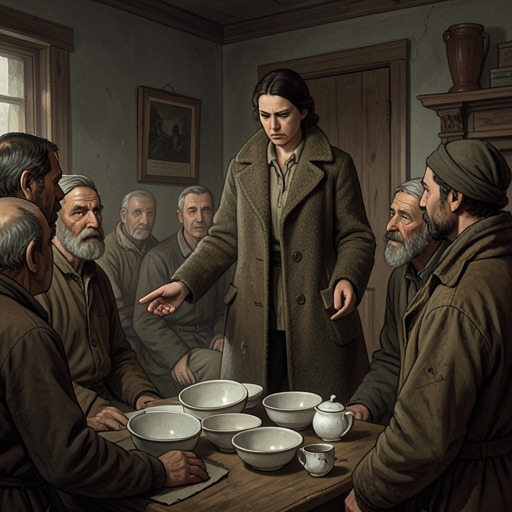
Gossip and social surveillance
The House of Bernarda AlbaGossip and social surveillance in The House of Bernarda Alba are not merely background features of village life: they are a means of enforcing its social order. Because neighbors watch, listen, and judge, the possibility that private conduct will become public shapes how people speak, behave, and protect a family name. The result is a community in which reputation can become more important than compassion or truth.
Community and Everyday Scrutiny
The play presents gossip as part of the ordinary life of a tightly knit village. Residents discuss land and inheritance disputes, and private conflicts can become public knowledge with lasting consequences for a family’s standing. Prudencia’s account of her husband’s quarrel with his brothers shows that a dispute over property is not confined to the family: common gossip turns it into a source of damaged reputation and family distress.
The arrival of the harvesters also places the household within a wider village rhythm, where people’s conduct and relationships are visible to others. This communal scrutiny is not limited to exceptional scandals. It forms part of the everyday social environment that the play’s realistic portrayal evokes, extending beyond Bernarda’s household to other families and communities across provincial Spain.
Reputation as a Discipline Within the Household
Bernarda’s fear of public judgment shapes the rules she imposes at home. She is anxious that her daughters might provoke gossip, and she insists that their arguments must not be heard by the neighbors. The walls that shelter the family also make it vulnerable to listening ears: the prospect of being overheard is enough to make household members monitor their own speech.
Her concern for appearances reaches beyond the daughters’ conduct. She criticizes the Servant over the house’s cleanliness before the mourners arrive, treating the impression made on visitors as a matter of household standing. This attention to outward respectability sits alongside Bernarda’s cruelty and lack of compassion. Her priority is less the truth of what happens inside the house than the story other people might tell about it.
Gender, Sexual Conduct, and Public Shame
Surveillance falls especially heavily on women. The play’s account of village life connects sexual conduct to family honor: women’s behavior is judged publicly, while men’s greater sexual freedom is more readily accepted. Bernarda condemns Paca la Roseta for her conduct, and her response to the unmarried young mother at the end of Act Two shows how quickly the community’s moral judgment can harden into hostility rather than sympathy.
This double standard makes reputation a gendered burden. Bernarda expects her daughters to avoid behavior that could invite public talk, even as the norms around them grant men broader freedom. Her insistence, after Adela’s death, that the villagers be told her daughter died a virgin is the starkest example of the family’s effort to control the public account of private life. Protecting the family name takes precedence over acknowledging what has happened.
Money, Silence, and the Play’s Wider Critique
Gossip also intersects with wealth and inheritance. Angustias’s money and engagement provoke resentment among her sisters, who recognize that her inheritance makes her a desirable match. Their discussion makes the marriage’s economic dimension visible, while the household’s unspoken suspicions reveal how property can intensify rivalry and secrecy. An earlier revelation that Antonio María Benavides left Angustias more money than his four natural daughters raises a further question about the household’s hidden relationships; the play leaves that possibility unresolved, making silence itself part of the pattern of suspicion.
By showing how public judgment enters private rooms, the play makes surveillance a mechanism of social control rather than a neutral habit of conversation. Its reach is reinforced by gender roles, family honor, and economic hierarchy: people fear not only what neighbors may know, but how that knowledge may alter a household’s standing. The result is a social world in which concealment protects appearances, while the pressure to preserve them deepens conflict.